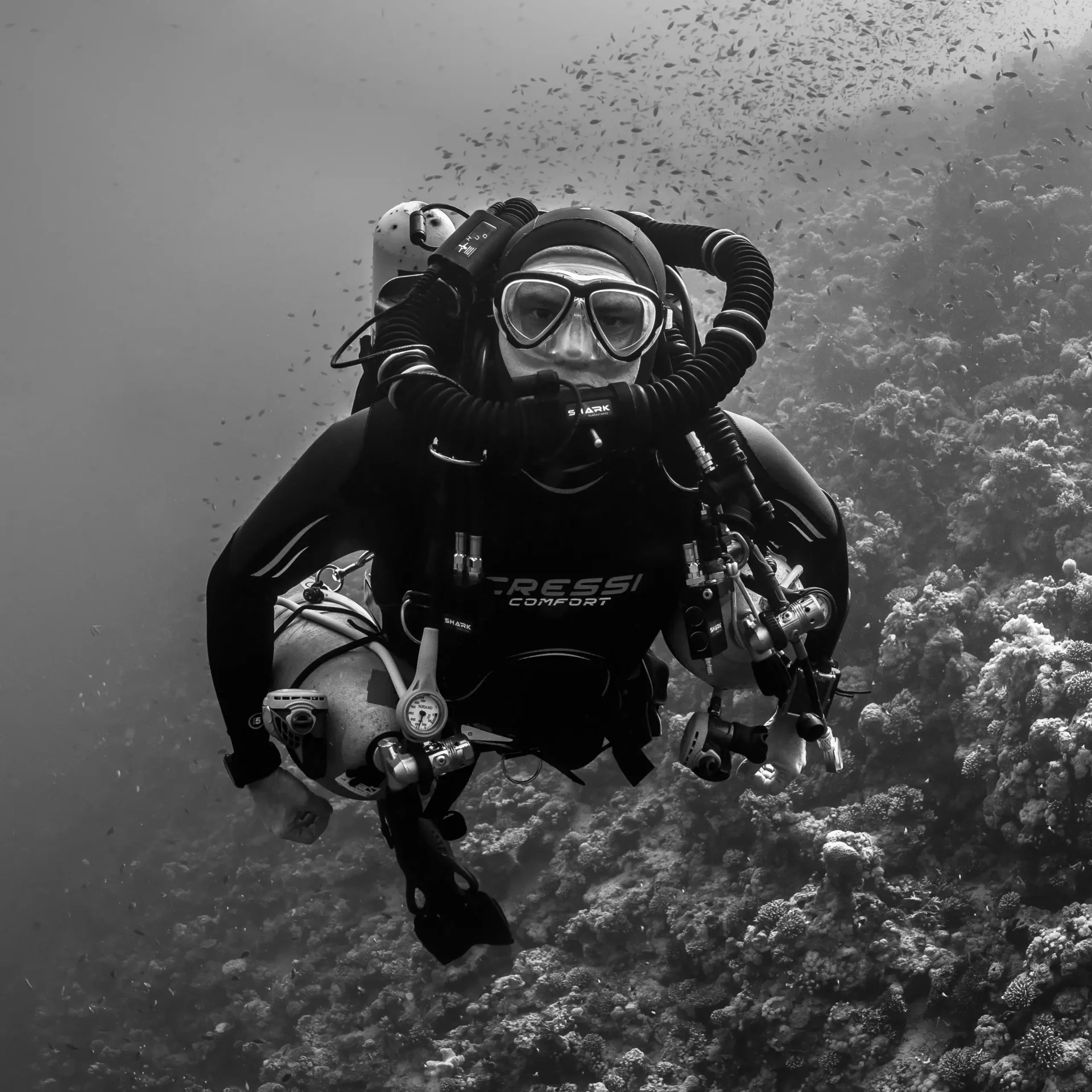
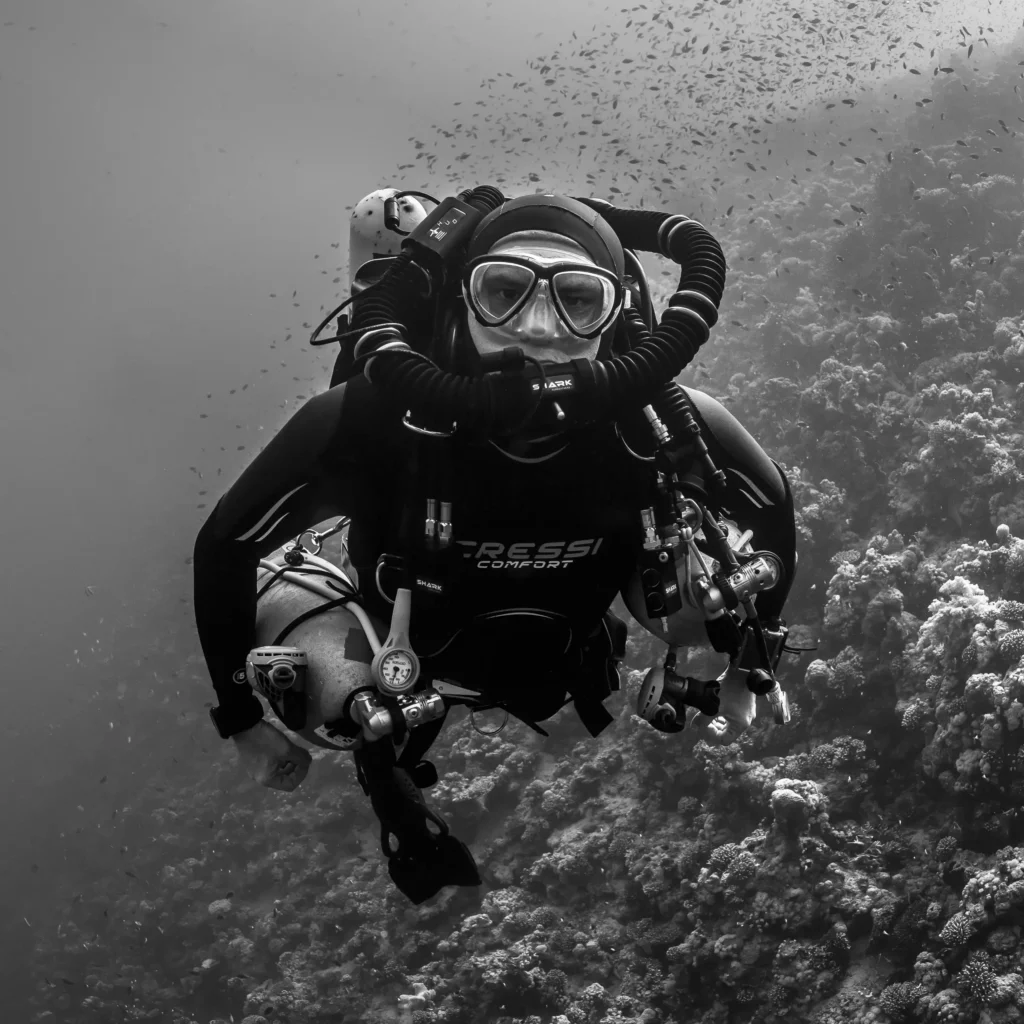

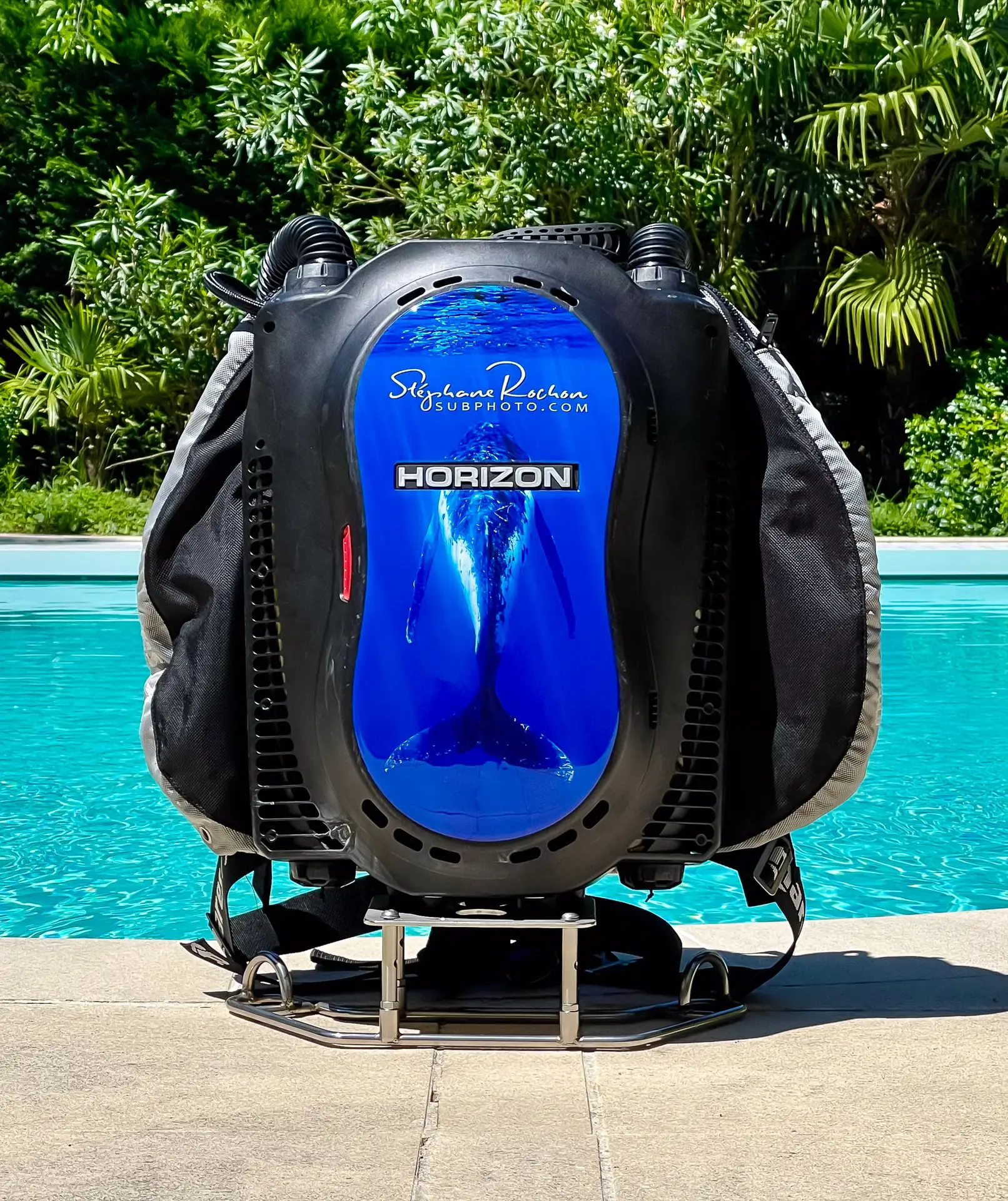
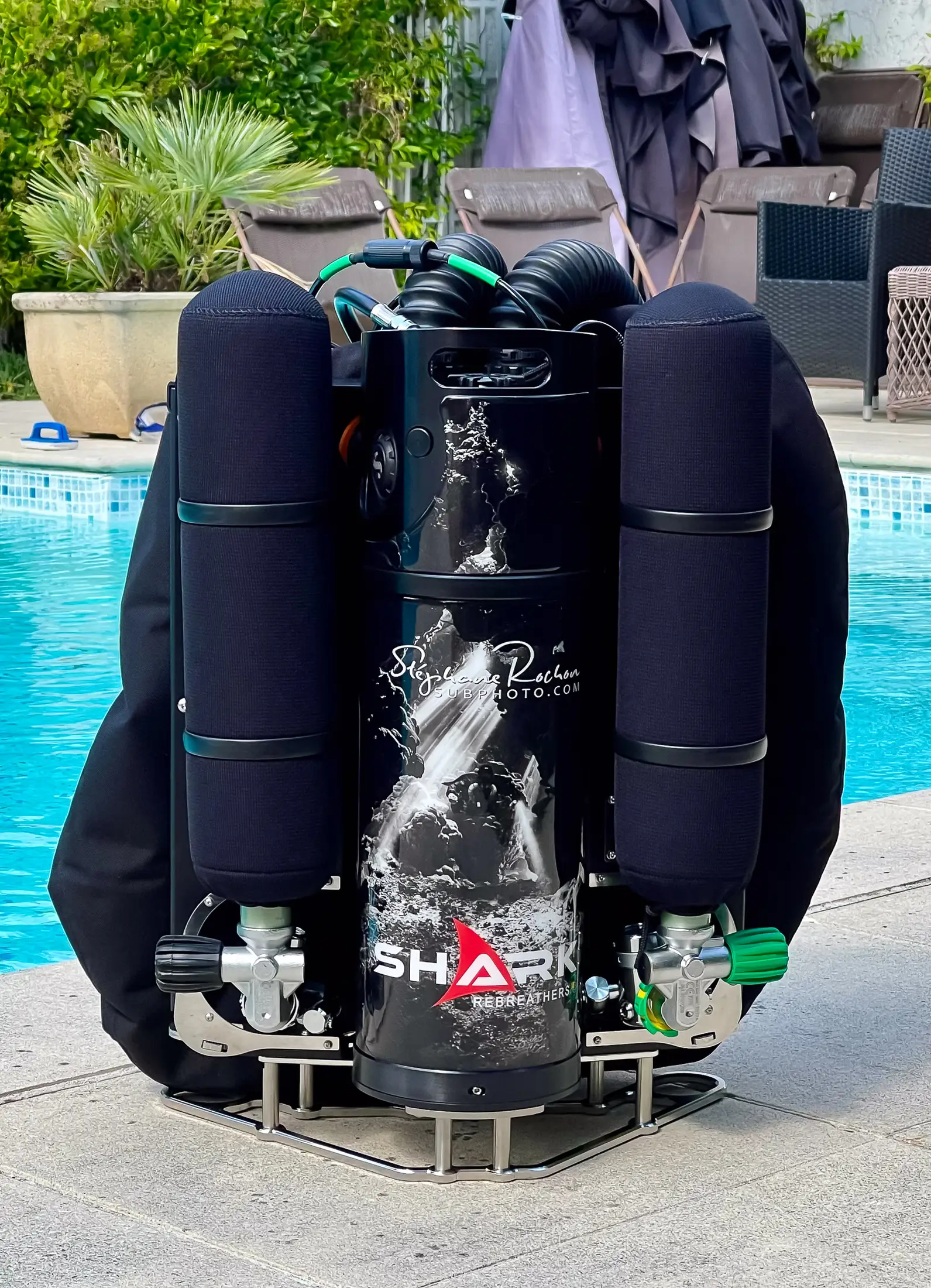
In conventional scuba diving, every exhale goes through the regulator and escapes as bubbles. With a rebreather, the exhaled gas is scrubbed of carbon dioxide, topped up with oxygen and breathed again. For the diver, it’s a different way to breathe; for the underwater photographer, it’s a different way to work. I’ve been diving open circuit since 1990, on a semi-closed rebreather (Mares Horizon) since 2023 and on a closed-circuit rebreather (Shark Rebreathers) since 2024, down to 230 feet (70 m) on normoxic trimix.
Silence
On open circuit, it’s not so much the bubbles that cause trouble as the regulator’s exhaust valve: with every exhale, it makes a sharp “clack” that really bothers marine life. Sharks, rays, whales and dolphins, and schools of fish associate that sound with an intruder and keep their distance. On a closed circuit, there’s no exhaust valve and no bubbles: the approach becomes silent, animals get more curious and tolerate you much closer. It’s often the difference between a distant silhouette and a wide-angle portrait from less than three feet away.
On open circuit, to get close without scaring animals away, I used to hold my breath for long stretches. That’s not good practice: carbon dioxide builds up and causes headaches, and repeatedly holding your breath on scuba could alter the body’s gas exchange in ways that are still poorly documented, with a risk of decompression sickness that can’t be ruled out. Not to mention the risk of a lung overexpansion injury if you ascend, even slightly, while holding your breath. The rebreather does away with that dilemma.
Silence also changes the photographer’s behavior. Without the steady sound of your own breathing, you hear the reef, you’re more aware of what’s happening around you, and you become more patient.
Time
A rebreather uses very little gas: only the oxygen your body actually metabolizes is replaced. With my Shark, I can dive for up to 5 hours, and unlike open circuit, that time doesn’t depend on depth. The limits are set by decompression and by the scrubber material that absorbs the CO₂, no longer by what’s in the cylinders.
All that time has changed the way I shoot. I now sometimes stay 30 minutes in the same square yard, motionless, so that marine life gets used to me. The animals eventually go back to their natural behavior, and that’s when the best images happen.
The two types of rebreather work in completely different ways. On a semi-closed circuit, like the Mares Horizon, you breathe a nitrox mix of constant composition, chosen before the dive for the planned maximum depth. On a closed circuit, it’s the partial pressure of oxygen that’s kept constant: the rebreather continuously adjusts the mix, so at every moment you’re breathing the best possible nitrox for your current depth. Decompression obligations are kept to a minimum for the same bottom time.
Depth
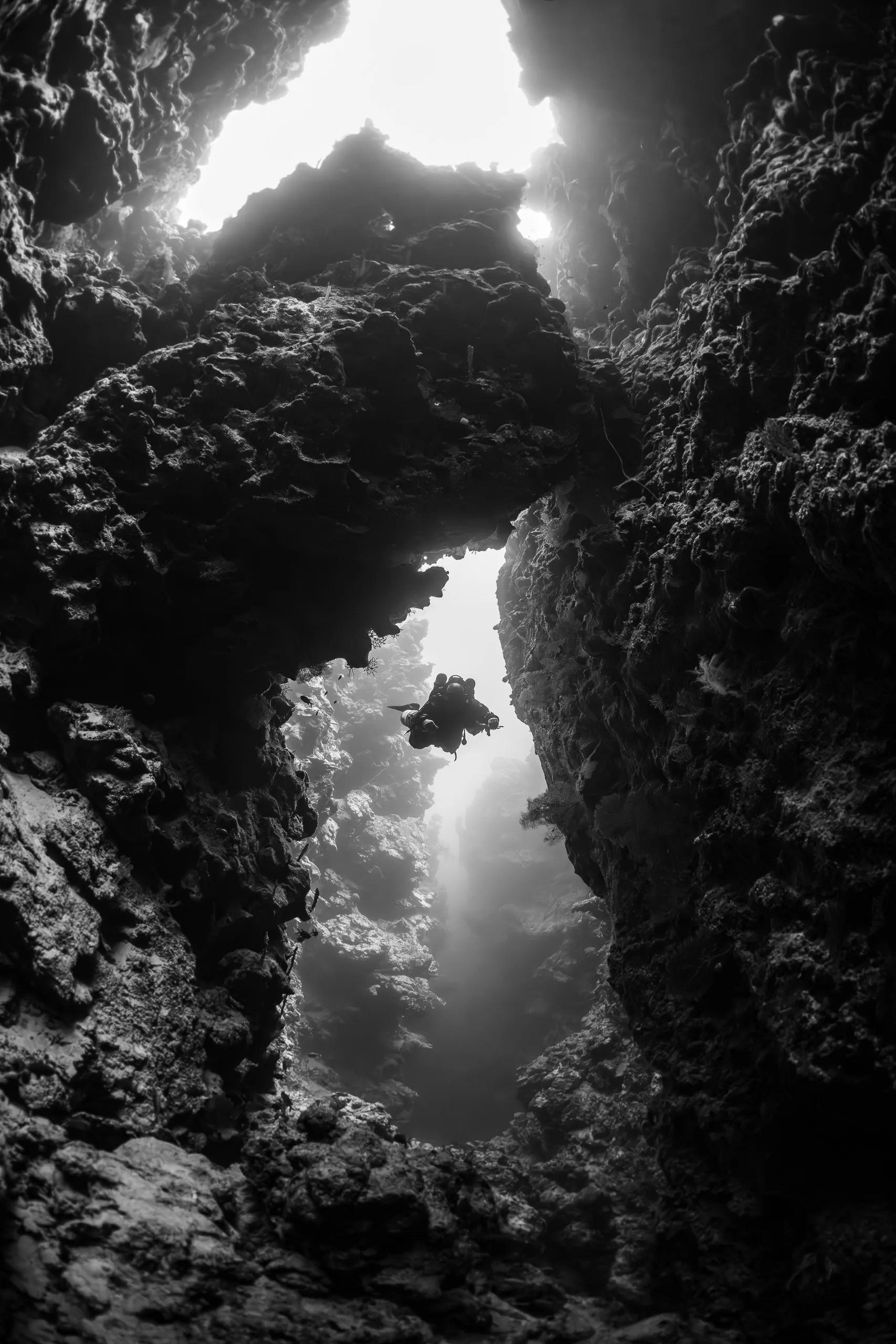
Documenting wrecks below 100 feet (30 m) without a rebreather now strikes me as completely outdated, even risky. On open circuit, you have a single gas source, nitrogen narcosis on air clouds your judgment just when you need to dive and shoot at the same time, and the volume of gas you have to carry quickly becomes huge on trimix. On a rebreather, trimix diluent changes everything: helium replaces part of the nitrogen and cancels out the effects of narcosis, which can set in as shallow as 90 feet (27 m) on air. You keep a clear head, with a comfortable gas reserve, and can focus on the image.
Other advantages
- Warm, moist gas: the recycled gas is warmed and humidified by the chemical reaction and by breathing, which reduces heat loss and dehydration on long dives.
- Wrecks and caves: with no bubbles, no particles get knocked loose from the ceiling to cloud the water in front of the lens.
The downsides
A rebreather isn’t magic. It takes specific training, regular practice and a lot of discipline: pre-dive checks before every dive, packing the scrubber, checking the oxygen cells, meticulous maintenance. The unit is heavier, more expensive and slower to set up than a standard scuba rig. Above all, mistakes are unforgiving: a mix with too little or too much oxygen, or a CO₂ buildup, can happen with no warning signs.
For photography, buoyancy is also trickier to manage. You can no longer fine-tune with your lungs the way you do on open circuit: the gas moves back and forth between your lungs and the counterlungs, and every change in depth means adjusting both your BCD and the loop volume. Staying perfectly still at the moment you press the shutter takes a lot of practice.
Finally, shooting on a rebreather means juggling several tasks at once, all the time:
- sticking to the dive plan: depth, time, decompression;
- keeping an eye on your buddy;
- running the unit: oxygen partial pressure, diluent, loop volume;
- handling the camera, its settings and the lighting;
- watching the environment and the behavior of marine life.
That’s a very heavy mental load, and it takes a lot of experience to handle it calmly.
That’s why photography must never distract you from flying the unit. On a rebreather, you don’t just wing it as a photographer: first you become a confident rebreather diver, then you add the camera.
Want to take your underwater photography further? Check out my coaching or browse the underwater world galleries.