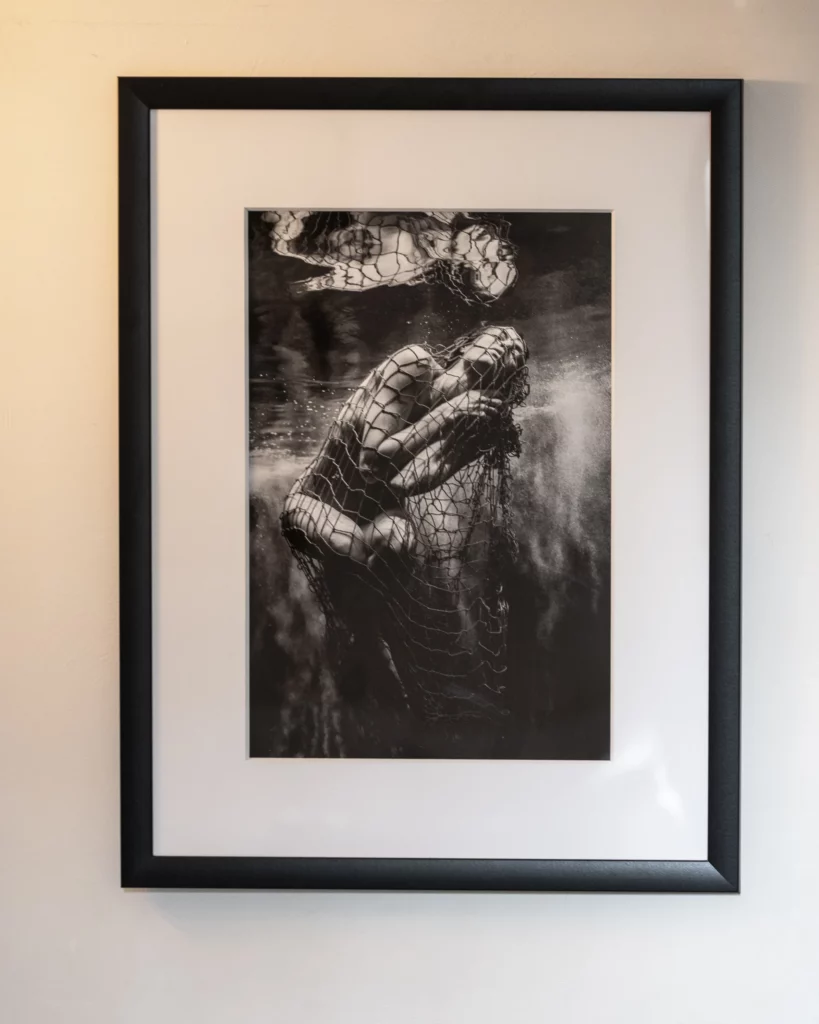

An underwater photo can look stunning on screen and disappointing on paper. The blue turns into a washed-out cyan, the shadows block up, and particles you never noticed suddenly appear. Here’s what happens between the dive and the print you hang on your wall.
A screen emits light, paper reflects it
Going from an image on a screen to an image on a sheet of paper means changing worlds. A screen emits its own light and builds its colors from red, green and blue. A print only reflects the light in the room, and its colors come from inks, starting with cyan, magenta, yellow and black. The two worlds don’t fully overlap: some colors can’t be displayed, others can’t be printed. That’s the whole challenge.
And underwater, it isn’t all blue: fish and corals are among the most colorful subjects there are. To do them justice, the printer has to render the widest possible range of colors.
Blue, the hardest color to print
Underwater, everything is blue: the gradient of open water, sun rays, the shadow of a shark. These very smooth gradients are tricky: if they’re not prepared properly, they break into visible bands or shift toward cyan. To make sure what I see on screen is what comes out on paper, the whole chain is calibrated. My monitors are calibrated every two weeks with a Datacolor Spyder Pro, and I print with the ICC profiles Canson provides for my printer and each of my papers. On top of that, I apply a personal adjustment, refined over many prints, that lifts the brightness of neutral tones: without it, an underwater image always looks a little darker on paper than on screen.
Getting it right in camera
My approach is that of an old-school photographer: I’d rather make an image than fix it afterward. Underwater, in the ocean as in my pool, I work my lighting as carefully as I can to get the most finished image possible straight out of the camera. I’m not a fan of heavy retouching.
Every file starts in Lightroom, from the camera’s raw file: cropping, exposure and above all white balance, the trickiest step in underwater photography. Three times out of four, the image then goes into Photoshop to refine details and remove particles.
For underwater portraits, I also make the small fixes that matter to the person photographed, when they ask: a blemish, a mosquito bite, a small scar, sometimes a swimsuit tan line. I can spend up to half an hour on a single image.
Blacks and particles
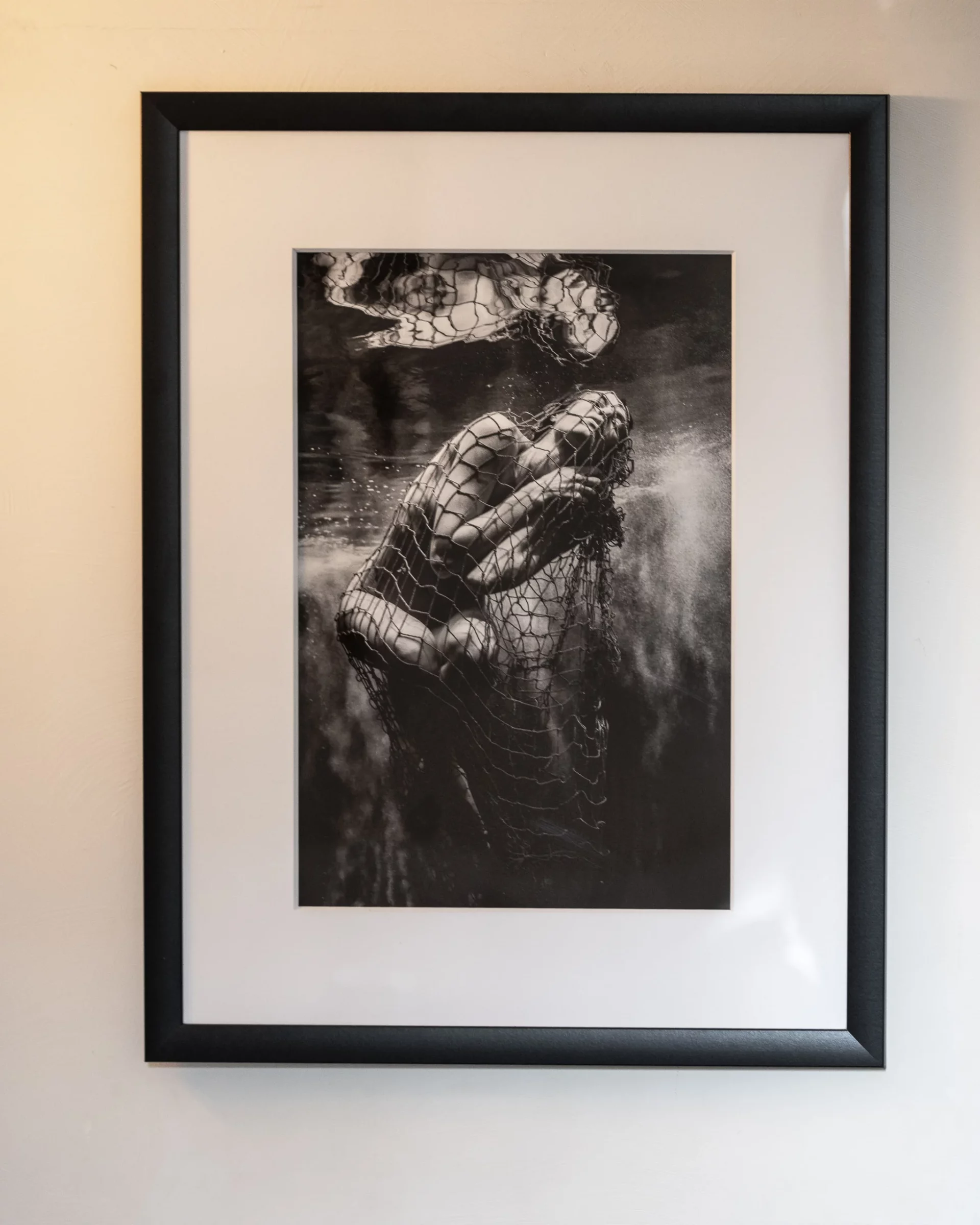
A night dive or a wreck relies on deep blacks. On thin or matte paper, black quickly looks grayish; on thick, high-quality fine art paper, it stays dense. Another trap: suspended particles. Water is never perfectly clear, in the ocean or in a pool, and enlargement reveals what the screen was hiding. So I remove them while viewing the image at print size, not at screen size.
The printer and the paper
I print every order myself on a Canon imagePROGRAF PRO-1000. I chose it for its twelve inks and its gorgeous output. The number of inks is key: beyond the four basic colors, each extra ink lets the printer reproduce more nuances, in blue gradients as well as in the bright colors of a reef. Its pigment inks also last far longer than standard inks. I use two very heavy Canson Infinity fine art papers: one for color, the other for black and white, each chosen for how it renders that kind of image. Before it’s packed, every print is checked in daylight, in a large, very bright office. Prints are delivered unframed.
Which size for which image
| Size | Dimensions | Price | Best for |
|---|---|---|---|
| A4 | 8.3 × 11.7 in (21 × 29.7 cm) | €49 | An animal portrait, a macro detail |
| A3 | 11.7 × 16.5 in (29.7 × 42 cm) | €99 | Most images, above a desk |
| A3+ | 13 × 19 in (32.9 × 48.3 cm) | €119 | A scene with divers, a school of fish |
| A2 | 16.5 × 23.4 in (42 × 59.4 cm) | €149 | Open blue water, a manta ray, a wreck: images that need room |
The smaller the subject in the frame, the bigger the print should be. A hammerhead far off in the blue becomes a dot in A4; in A2, it fills your field of view.
Signed, numbered, limited editions
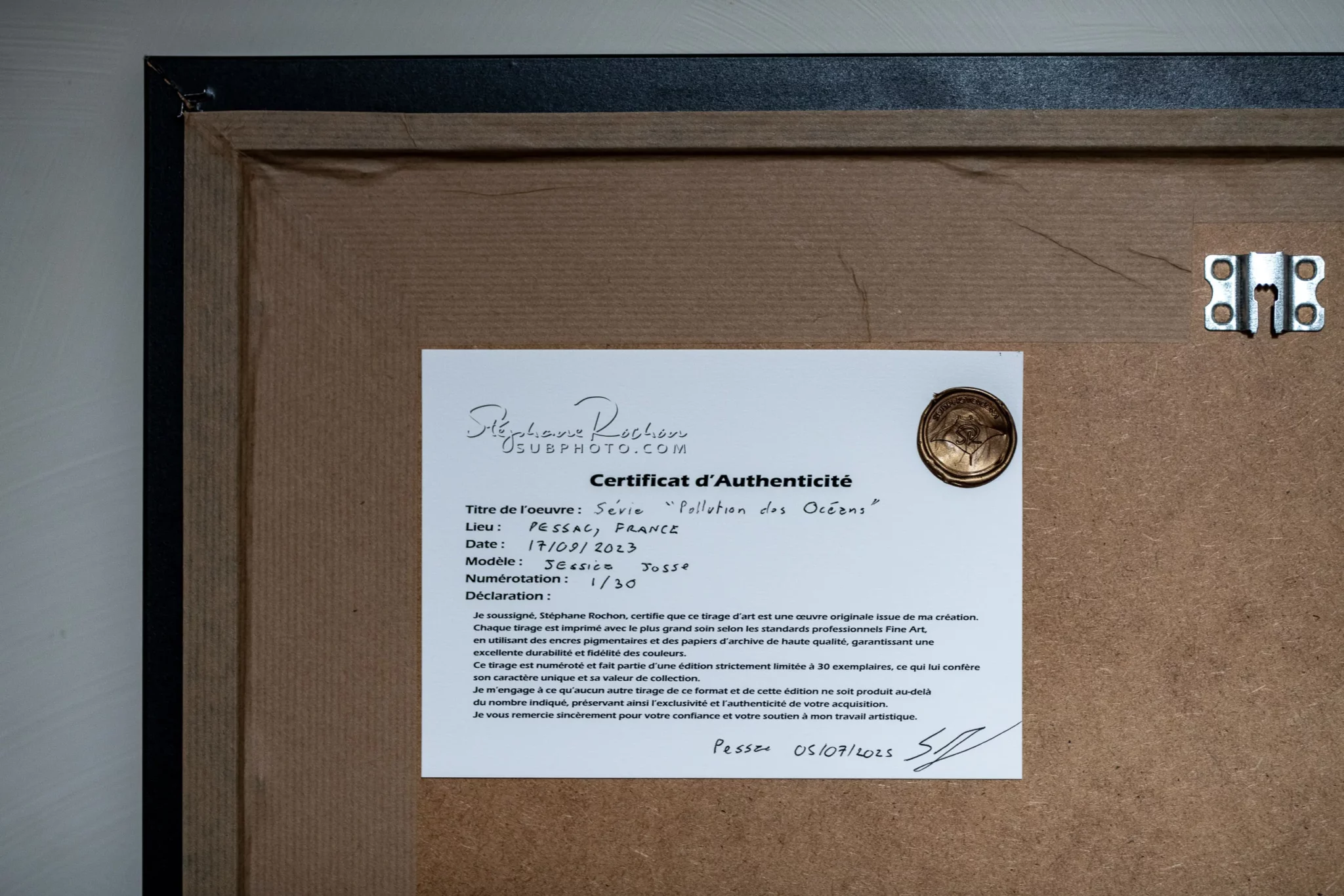
In France, a photograph only qualifies as a work of art if its author limits the edition to 30 copies at most, all sizes and media combined, each one signed and numbered. I follow that rule: every print I sell carries my signature and its number, and no image will ever exceed 30 copies.
Nothing forces me to go up to 30. For some images, I may choose a shorter edition, down to a one-of-a-kind print. That’s what makes a fine art print rare, and what sets it apart from a poster. Each product page in the shop shows how many copies are still available.
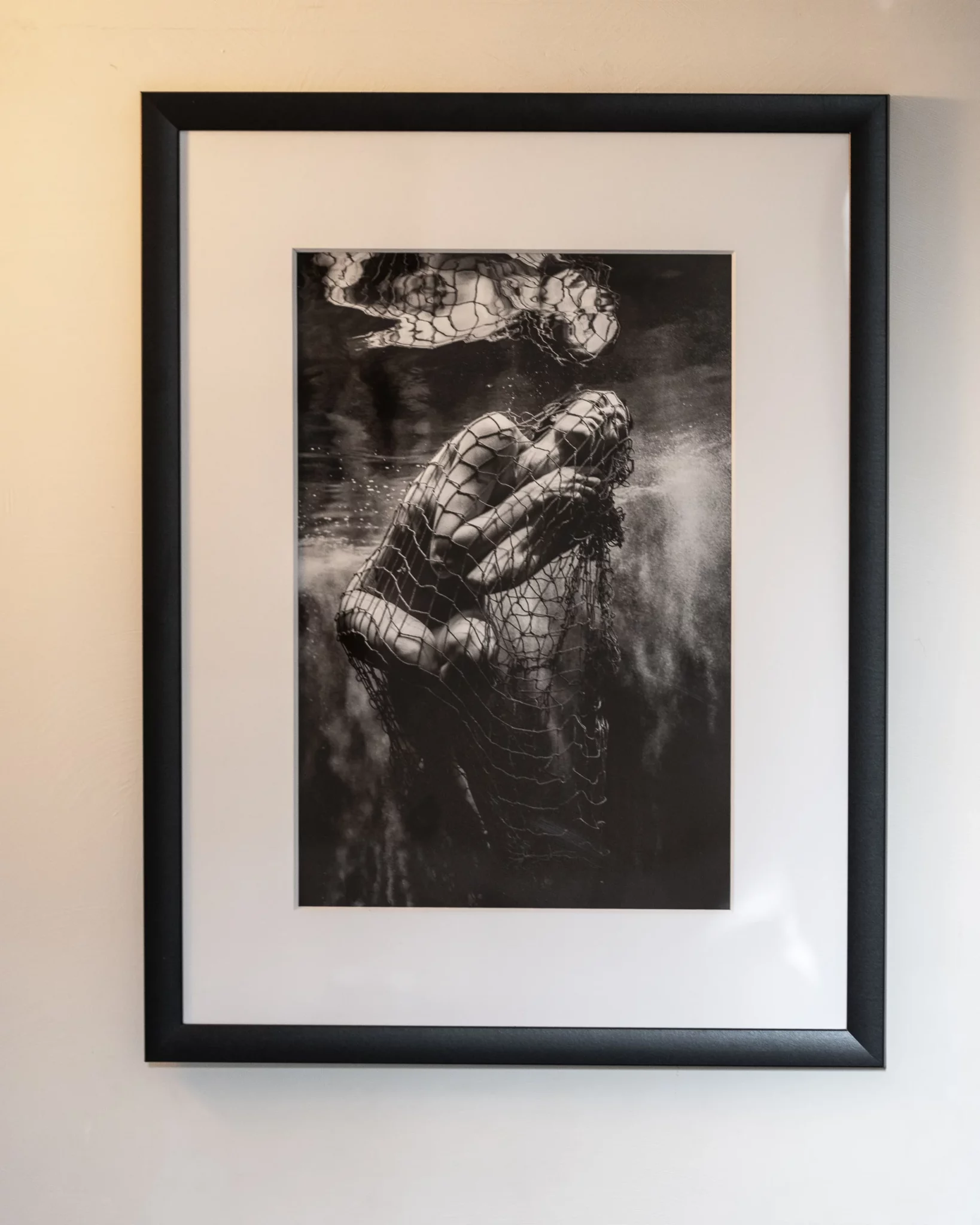
Large formats and framed prints
Beyond A2, I make larger prints on request, framed or on other media. They come with a certificate of authenticity and count toward the image’s 30-copy limit. Get in touch to discuss your project.
If you’d rather use the image than hang it
Every photo in the shop is also available as a licensed high-resolution file, ready to download right away: Standard at €29, Extended at €99. To choose, read Standard or Extended license: which one do you need?
Explore the 7,600 images in the shop, by species, environment or destination.